Period Piece: DITTO Raises $6M to Make Clinical Evidence the Price of Entry in Menstrual Supplements
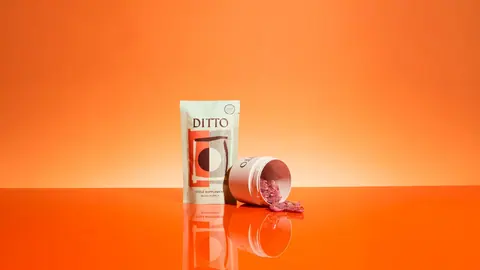
On July 28, 2026, London-based menstrual health company DITTO announced a €5.2 million ($6 million) Seed round led by FoodLabs, with participation from returning investor Eka Ventures and a group of angels. The money funds three things: more in-house research, an expanded science-led supplement range, and reach. It follows the company's £1.35M pre-seed in August 2025 — a fast step-up for a company founded in 2024.
DITTO was co-founded by neuroscientist and nutrition scientist Alice van der Schoot and Adam Kugler, a former Brand Director at L'Oréal. That pairing is the whole thesis in miniature: a research operation with a consumer-brand engine bolted to it. Its flagship product, Premenstrual Daily, targets PMS and PMDD symptoms — fatigue, mood changes, pain — with ten nutrients including omega-3, magnesium and saffron, delivered via time-released beadlet biotechnology intended to improve absorption. The company says an initial clinical study saw 88% of participants report symptom improvement, and that the product has since entered a larger trial plus a real-world evidence study.
Standard caveats apply and should be stated plainly: an 88% self-reported improvement figure from an initial company-run study is a signal, not proof. Supplements are a category where the FTC has historically had to police claims aggressively, and menstrual and hormonal supplements are among the noisiest corners of it. What distinguishes DITTO's positioning is that it is explicitly racing toward the harder evidence rather than away from it — the larger trial and real-world evidence study are the interesting part, not the pilot.
Van der Schoot's framing of the problem is the sharpest articulation of the market gap: "Too many women are told their concerns are normal, or that they're being dramatic, and sent away without answers. Until DITTO, there was nowhere for women to find research about what they were going through, or science-led solutions built for the reality of what they were living." The company also publishes research on under-studied menstrual health topics — including the relationship between PMDD and ADHD — and says it translates emerging studies for a community of over 300,000.
The company's own stated view of where the category is heading: in menstrual health, clinical evidence is becoming the price of entry, and the first company to set that standard becomes the benchmark everyone else is measured against.