Uncanny Valley of the Dolls: A $6.6B Market Meets the Question Nobody Has Data For
On August 29, 2026, The Guardian published a long investigation into the booming sex doll industry, pegged to a bizarre Australian incident earlier this month: on August 9, NSW Police announced a "body in a suitcase" had been found on a dirt road near Goulburn, three hours south of Sydney. Forensic examination the next morning determined the "body" was a lifelike doll — clothed, with hair, a nose piercing, and painted-on bruises. Because it did not resemble a child, no offence had been committed and the investigation was closed. The story cites a 2026 market analysis valuing the global sex doll market at US$6.6bn in 2025 and projecting US$13.4bn by 2033.
The technology is what has changed. RealDoll's forthcoming Harmony model, currently waitlisted, lets buyers assign personality traits like "spiritual" or "insecure" from a phone app, and includes what the company markets as an AI vagina — "an electronic insert that pairs via Bluetooth to the X-Mode App," detecting touch, movement and speed with synchronized vocal responses. At CES 2026, Lovense introduced Emily, an AI-powered companion doll with personality switching across modes including "co-worker," "gym crush" and "tradwife," AI-generated selfies on request, conversational memory, and body sensors that trigger vocal response. Lovense's own marketing frames it around "routine companionship" and "building confidence through judgement-free connection." The waitlist points to Q1 2027 shipping.
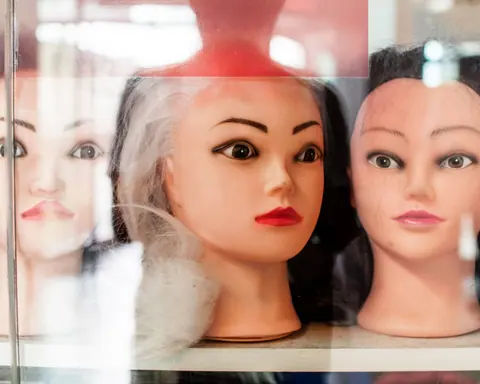
The consent question the piece surfaces is the sharpest one for the industry. Los Angeles accessories brand Coeros sells custom doll heads modeled on uploaded reference photographs of "a real person, an original character, or an AI-generated image," claiming roughly 90% resemblance for about US$1,790. Asked what safeguards exist if a customer submits photos of a woman without her knowledge, a Coeros spokesperson told The Guardian that "the fact that a custom design can be created from reference images should not be interpreted as permission to use another person's likeness without their consent," and that the company does "not encourage or support the use of our customisation service for harassment, impersonation, or other non-consensual purposes." The Guardian reports the site's ordering flow does not appear to require any attestation of consent from the person depicted.
On the harm question, the research is genuinely unsettled. Johannes Fuss, chair of forensic psychiatry and sex research at the University of Duisburg-Essen, told The Guardian that "we currently lack robust longitudinal data to definitively prove whether such doll use is protective or, conversely, is a behavioural stepping stone that increases real-world offending risk," and called for urgent research "as more and more technologies enter the market to simulate human sexuality." Retailer Tammie Paine of Adelaide's Naughty by Nature Adult Store pushed back on stereotyping customers, saying one confronting image "shouldn't be used to characterise an entire group of consumers."
Sources
- AI vaginas, customisable personalities and fake bruises: the sex doll market is booming — The Guardiantheguardian.com
- 'Body' found in suitcase near Goulburn was actually lifelike doll with 'bruises and grazes' — The Guardiantheguardian.com
- A 'body' found in a suitcase was actually a sex doll. How did NSW police get it so wrong? — The Guardiantheguardian.com