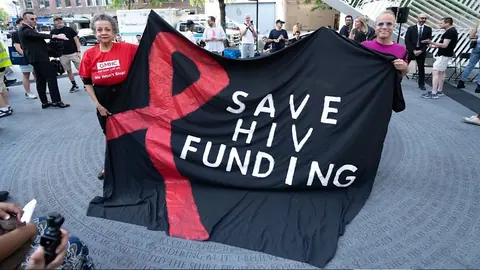
The Safety Net Didn't Hold: First Hard Data Shows HIV Prevention and Testing Fell by Half to Two-Thirds After US Aid Cuts

On October 5, 2026, the London School of Economics and Duke University released an interrupted time-series study in The Lancet Global Health. It is the first to measure what happened inside HIV-service organisations whose US funding was cut in January 2025 and never restored. The study is led by Dr Henry Cust (LSE Fellow in Health Policy, formerly of Duke's Sanford School of Public Policy) with Sungai T. Chabata and partners in both countries. It tracked monthly and quarterly service data from January 2023 to March 2026 at four NGOs in Uganda and Zimbabwe that mainly serve key populations, including sex workers, men who have sex with men and other groups at highest risk of HIV.
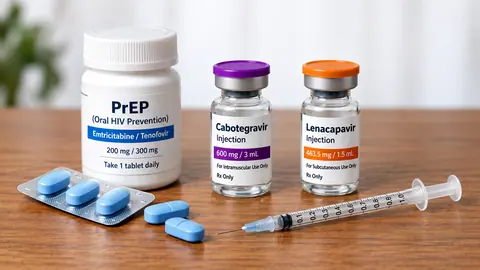
The declines were large and persisted. Normalising each service area to an index where 100 equals the 2024 average, the authors estimate that after the February 2025 interruption point prevention fell 36.8–62.7 index points, PrEP 43.0–71.6, testing 58.7–63.8, and antiretroviral treatment 22.0–31.5. Index points are roughly equivalent to percentage change. Services "remained substantially below the 2024 amount up to March 2026." The humanitarian waiver meant to protect life-saving treatment "attenuated treatment effects but did not prevent substantial decline." Eight organisations agreed to take part, and four were excluded for data quality, lack of funding impact or location.
"In the organisations involved, services used successfully to tackle the HIV epidemic in sub-Saharan Africa fell by between a half and two thirds, largely remaining there through to March 2026. The safety net that was supposed to preserve life-saving treatment did not hold," Cust said in the LSE release. Byrone Chingombe of CeSHHAR Zimbabwe described the damage to trust: "The vulnerable populations we take care of do not trust our services anymore. They say, 'you went away without any notice… you left us with nothing.'" The authors call for emergency transition funding, service-continuity protocols and more stable domestic financing to prevent a rebound in HIV incidence.
Sources
- New study finds major HIV service declines in Uganda and Zimbabwe after 2025 US aid cuts — London School of Economics (Oct 5, 2026)lse.ac.uk
- Cust H, Chabata ST, et al. HIV service delivery after the PEPFAR and USAID HIV funding withdrawal in Uganda and Zimbabwe: an interrupted time-series study. The Lancet Global Health — DOI 10.1016/j.langlo.2026.104061 (abstract via Europe PMC)ebi.ac.uk