Last Call at the Corner Machine: Japan's Condom Vending Network Is Running on Spare Parts, and Sagami Keeps the Survivors Alive by Hand
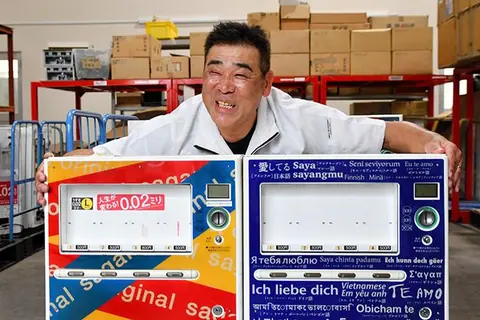
On November 14, 2026, the Asahi Shimbun published a look inside Sagami Rubber Industries, one of Japan's two big condom makers, and the three-person team that keeps the country's last condom vending machines working. Japanese manufacturers, Sagami included, stopped building condom vending machines about 25 years ago, so every unit still in service is at least a quarter-century old. In a workshop at Sagami's Atsugi headquarters in Kanagawa Prefecture, the team takes in machines returned from closed shops, strips them for parts and refurbishes about 10 a month. "Even if 100 machines come back, about 30 have no usable parts left and must be scrapped," repairman Atsushi Takahashi, 57, told the paper. The team's oldest member is 71, and Takahashi puts their average age at 63. Sagami says it is the only condom maker in Japan that still repairs its own machines.
The numbers show a sales channel in terminal decline. At their peak, Japan had about 30,000 condom vending machines, and in 1993 they generated an estimated ¥4 billion (about $255 million) in annual sales nationwide. Sagami alone ran about 10,000 machines, mostly outside independent pharmacies. By June 2026 that was down to 1,540. Machine sales fell from 1.14 million condoms worth ¥105 million in fiscal 2018 to 410,000 units worth ¥51 million in fiscal 2025, and the company says only three or four machines nationwide take in more than ¥10,000 a month. By our math, that works out to roughly ¥33,000 a year and about 270 condoms per machine, and an average price per condom that rose from about ¥92 to about ¥124 over the period. Rival Okamoto Industries, known for its "Bright family planning" slogan, ran roughly 10,000 machines at its peak and now has about 250.
"As a business, it's not rational. It's a money-losing business," said Sagami director Muneto Tamagami. "But as long as there are customers buying from them, we can't simply shut it down." He added that "the challenge now is figuring out how to reshape the business so that it remains viable." Takahashi's explanation for the decline is simple: "Convenience stores have increased, so people can buy condoms anytime. Online shopping also lets people buy them without meeting anyone face to face." Okamoto's condom chief Shoma Wada, who also guest-lectures in junior-high sex-education classes, made the case for what the machines did: "When young people became curious about sex, vending machines allowed them to encounter condoms naturally." He added: "People tend to see condoms as adult goods, but that's not what they are."
The decline is happening alongside a wider retreat of Japan's vending industry. Vending Times, citing Seoul Economic Daily, reported in October that rising ingredient, transport and maintenance costs and population decline are pushing beverage companies to pull underperforming machines, leaving some remote islands with none at all.
Sources
- Repair worker laments steady loss of machines selling condoms — The Asahi Shimbun (Sakura Kawamura, Nov 14, 2026)asahi.com
- Um técnico lamenta a constante perda de máquinas de venda de preservativos — IPC Digital (Portuguese-language report of the Asahi feature, Nov 2026)ipc.digital
- Rising costs squeeze vending service on Japan's remote islands — Vending Times (Oct 21, 2026)vendingtimes.com