Half the Country, Zero Hearings: Congress Finally Books a Room for Menopause
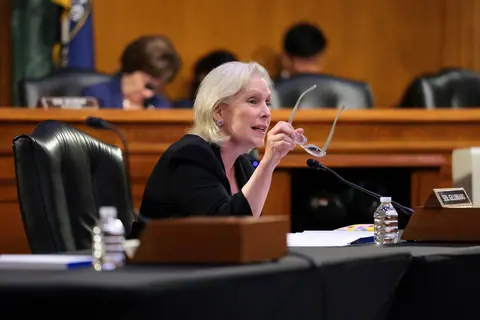
On September 16, 2026, the U.S. Senate Special Committee on Aging held the first congressional hearing ever devoted to menopause — a full committee hearing at 3:30pm in SH-216, titled "Half the Country, Zero Hearings: Meeting the Moment to End the Menopause Care Gap in America." Ranking Member Kirsten Gillibrand (D-NY) convened it; Chairman Rick Scott (R-FL) presided. The 19th's Shefali Luthra and Isabela Espadas Barros Leal covered it the same day.
The hearing came packaged with a concrete ask. Gillibrand and Scott sent a bipartisan letter to the Government Accountability Office — co-signed by Sen. Angela Alsobrooks (D-MD) and three Democratic women in the House — requesting a report on "the federal government's role in advancing research, ensuring access to evidence-based treatments, and strengthening oversight of existing programs." Gillibrand's framing during the hearing was characteristically direct: the GAO review "will tell us what the federal government actually does on menopause, how well our doctors are trained and where the gaps are. You can't fix what you refuse to even measure."
Witnesses included Jean Wactawski-Wende, PhD, dean of the School of Public Health and Health Professions at the University at Buffalo, who told the committee that "women's health research, particularly in older women, has been underfunded. We need studies that further examine how hormonal changes across the lifespan influence healthy longevity." Several speakers praised the FDA's recent removal of the black box label from some hormone treatments while pressing for research covering a more diverse patient population, and at least one described her own difficulty obtaining insurance coverage for menopause treatment — including the estradiol patches that have been in chronic short supply.
Two threads from the testimony matter to anyone building in this category. The first is misinformation as a clinical problem. Pennsylvania OBGYN Dr. Lynne Coslett-Charlton told the committee that "menopause has become big business, and many women are turning to influencers rather than trained clinicians for advice. Much of my time is spent counseling patients about different supplements and unregulated products marketed online on different platforms." She also recounted a patient in her mid-20s asking about perimenopause symptoms — "Perimenopause has a vibe, and I want to be ready." The second is sexual health specifically: witnesses urged that hormonal changes be treated as prevention, not symptom management, citing heart disease, bone loss and genitourinary syndrome of menopause, the condition underlying the vaginal dryness and pain during sex that many women experience in their 40s and 50s.
On the economics, roughly 30% of women in the workforce are between 45 and 60. RAND Corporation estimates menopause symptoms cost about $5.4 billion annually, largely through early retirement and reduced workforce participation; Gillibrand said during the hearing that "as many as one in 10 women leave the workforce because of menopause." Jennifer Weiss-Wolf of NYU Law's Birnbaum Women's Leadership Center, who testified, added: "This issue has way more resonance than members of Congress or everyday voters realize." The 19th notes multiple menopause bills are pending in Congress — research funding, medical education, workplace accommodations — and that none are likely to pass before the November midterms.