The Big T Rebound: Testosterone Prescribing Hits a New High as the FDA's Warning Lift Bites
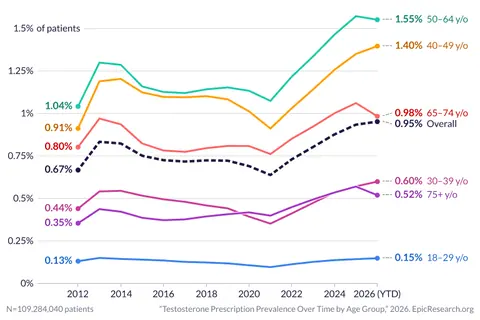
On July 29, 2026, Epic Research published a large-scale analysis showing that testosterone prescribing in the United States has not only recovered from a decade-long slump but pushed past its early-2010s peak. Drawing on records for 109 million men aged 18 and older with at least one healthcare encounter between January 2012 and June 2026, the study found the share of male patients on an active testosterone prescription fell from 0.83% in 2013 to a low of 0.64% in 2021 — then rebounded to 0.93% in 2025 and 0.95% in the partial first half of 2026, an all-time high across the study window.
The turnaround is broad rather than a niche-clinic quirk: every age group 30 and older surpassed its early-2010s peak by 2025. Men aged 50–64 carried the highest prevalence at 1.57% in 2025 (up from a prior peak of 1.30% in 2013), while men aged 18–29 remained lowest at 0.14%. That age gradient matters for the sextech and men's-health beat, because the 50–64 cohort is exactly the demographic that direct-to-consumer telehealth brands — Hims, Ro, and a wave of TRT-focused startups — have spent the last few years courting with low-friction online intake and home lab kits.
Epic's analysts tie the reversal to a specific regulatory inflection point. In March 2015 the FDA required labeling changes cautioning that testosterone products are not approved for age-related low testosterone and warning of possible heart-attack and stroke risk; prescribing declined in the years that followed. But in February 2025 the FDA removed the boxed cardiovascular warning from all testosterone products after the 2023 TRAVERSE trial found no increased risk of major adverse cardiac events among hypogonadal men with elevated cardiovascular risk. The warning removal, combined with the explosion of telehealth and DTC men's-health services, appears to have uncorked demand that had been suppressed for the better part of a decade.
The data lands amid a noisy cultural moment for testosterone — from Defense Secretary Pete Hegseth's push to screen troops for low T, to WSJ and Washington Post explainers on who actually needs testing. Epic's numbers cut through the noise with a clean population-level signal: whatever the messaging, real prescriptions are climbing fast, and the prescribing base is aging into the highest-risk-for-hypogonadism years.
Sources
Story updates 1
Epic's follow-up: most men are tested before starting T, but few are tested by the guideline. On October 27, 2026, Epic Research published a second Cosmos analysis on the testosterone boom. This one asks whether diagnosis has kept up with prescribing. It looked at 300,277 men with a new testosterone prescription between January 2017 and June 2026:
- 82.6% of men starting testosterone in the first half of 2026 had some testosterone test in the prior 12 months, up from 72.3% in 2017. That figure peaked at 83.8% in 2024.
- Only 21.8% met Epic's lab-observable proxy for the American Urological Association two-test standard: two total-T results below 300 ng/dL on separate days within six months before the prescription. That share has hardly changed since 2017 (16.9%) and peaked at 22.8% in 2024.
- 40.8% had two or more tests on separate days of any result.
- Among new starters, the share with at least one low result fell with age, from 66.2% (ages 30–39) to 58.8% (75+).
- Primary care wrote 57.6% of new prescriptions, ahead of urology (17.4%) and endocrinology (11.0%). Endocrinology had the highest share with a documented low result (69.6%) and urology the lowest (60.0%).
Epic flags important limits. The proxy omits the AUA's early-morning and symptom requirements, external labs are missed, and DTC/telehealth TRT prescriptions are "likely under captured." That last limit matters most, because the fastest-growing channel is the one this dataset can't see.
What changed: The August story showed prescribing hitting an all-time high. This update shows that about four in five new starters in health-system records don't meet the lab bar the urology guideline sets for diagnosing deficiency. It arrives the same month Hims added injectable and oral TRT built around a single at-home capillary panel, and as the Pentagon's troop-screening order pushes testing toward asymptomatic men. If even traditional clinics mostly skip the two-test confirmation, regulators and plaintiffs looking at telehealth T will have a ready-made benchmark.